Hardware / Software / DSP
click on project titles to expand details
Analog-Modeled Digital Phaser Effect
[May 2020]
Designed basic analog i/o circuitry to be able to use Teensy 4.0 (ARM Cortex-M7) & SGTL5000-based 'Audio Shield' as a platform for developing digital guitar effects. Wrote custom classes extending the Teensy Audio Library to implement an analog-modelled phaser effect. Referenced DAFX for general design structure and studied schematics & frequency response analysis of common analog phaser pedals to tweak parameters. Current iteration is a 4-stage design based loosely on the EHX Small Stone with adjustable feedback.
more info soon
Designed basic analog i/o circuitry to be able to use Teensy 4.0 (ARM Cortex-M7) & SGTL5000-based 'Audio Shield' as a platform for developing digital guitar effects. Wrote custom classes extending the Teensy Audio Library to implement an analog-modelled phaser effect. Referenced DAFX for general design structure and studied schematics & frequency response analysis of common analog phaser pedals to tweak parameters. Current iteration is a 4-stage design based loosely on the EHX Small Stone with adjustable feedback.
more info soon
Pianosaic - Augmented Reality Musical Experience for Magic Leap 1
[April 2020]
Pianosaic is a musical exploration app for the Magic Leap 1 designed to allow users to explore spatial audio in an accessible format. The application allows the user to see, hear, and interact with various musical instruments and items in three-dimensional space. All in-game audio is “spatialized”, meaning that it will be perceived as emanating from a certain spot within the room: a sound source placed behind the user will sound as if it is actually behind them.
Pianosaic features a playable and rearrangeable 2-octave piano, a metronome, and an assortment of looping accompaniment tracks which play continuously when activated. Additionally, real-world sounds such as singing or other noises can be recorded and used as a looping accompaniment.
Pianosaic is a musical exploration app for the Magic Leap 1 designed to allow users to explore spatial audio in an accessible format. The application allows the user to see, hear, and interact with various musical instruments and items in three-dimensional space. All in-game audio is “spatialized”, meaning that it will be perceived as emanating from a certain spot within the room: a sound source placed behind the user will sound as if it is actually behind them.
Pianosaic features a playable and rearrangeable 2-octave piano, a metronome, and an assortment of looping accompaniment tracks which play continuously when activated. Additionally, real-world sounds such as singing or other noises can be recorded and used as a looping accompaniment.
Tube Preamp for Bass Guitar
[April 2020]
Original preamp/pedal (boost, od, EQ) design for use with bass guitar. Adjustable gain (clean to light overdrive), volume (with flat eq, max +8dB at minimum gain & +19dB at full gain), and EQ (treble/bass baxandall-style). Preamp can stay clean with up to ~2Vp-t-p on the input. Stacking a boost or drive in front of this preamp will push it into heavier distortion. Powered by 18VDC, generally available on pedalboard power supplies.
12AU7-based gain section uses a combination of cutoff/"cold-clipping" and grid clipping for a harmonically rich overdrive. Tone controls provide roughly +/-16dB of boost or cut, with voicing loosely inspired by the Ampeg SVT sound. 12AX7 gain stage provides clean gain at the output.
audio clips coming soon
Original preamp/pedal (boost, od, EQ) design for use with bass guitar. Adjustable gain (clean to light overdrive), volume (with flat eq, max +8dB at minimum gain & +19dB at full gain), and EQ (treble/bass baxandall-style). Preamp can stay clean with up to ~2Vp-t-p on the input. Stacking a boost or drive in front of this preamp will push it into heavier distortion. Powered by 18VDC, generally available on pedalboard power supplies.
12AU7-based gain section uses a combination of cutoff/"cold-clipping" and grid clipping for a harmonically rich overdrive. Tone controls provide roughly +/-16dB of boost or cut, with voicing loosely inspired by the Ampeg SVT sound. 12AX7 gain stage provides clean gain at the output.
audio clips coming soon
Wavebender - original guitar pedal design and implementation
[December 2019]
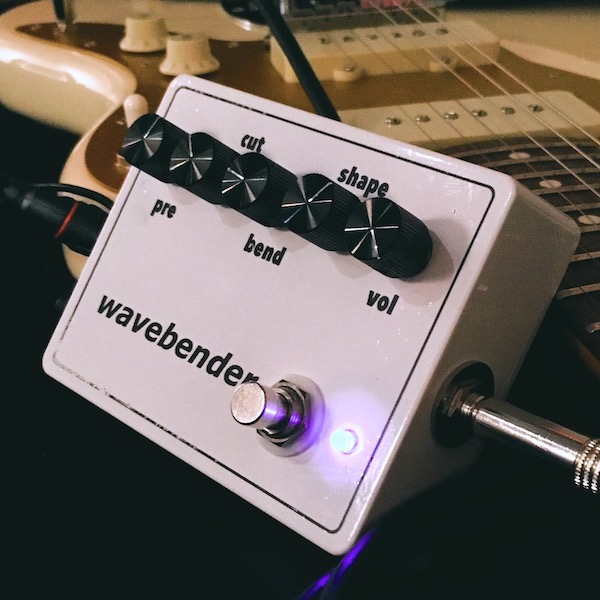
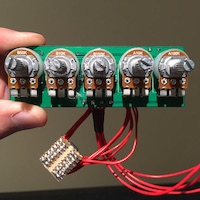
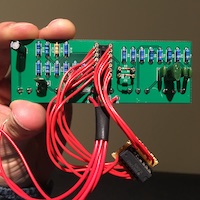
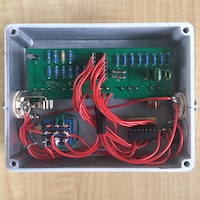
This project involved taking a vague idea for a new type of guitar pedal through the entire design process, resulting in a functional prototype unit. Specifically, the project involved original circuit design, simulation via LTSpice, breadboard prototyping, PCB design, component sourcing, assembly, debugging, and enclosure work.
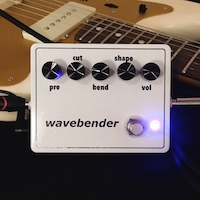
"The Wavebender is a unique guitar pedal based on a concept known as “wavefolding” borrowed from modular synthesis. Whereas a traditional fuzz pedal achieves its distortion by ‘chopping off’ the peaks of a signal, the Wavebender takes these peaks and inverts them. The core ‘wavefolding’ stage is accompanied by multiple stages of gain and filtering, and five control knobs offer deep manipulation of the sound. The result is a unique distortion that can be dialed in from a mild saturation to a harsh, 'torn-speaker' fuzz."
This project involved taking a vague idea for a new type of guitar pedal through the entire design process, resulting in a functional prototype unit. Specifically, the project involved original circuit design, simulation via LTSpice, breadboard prototyping, PCB design, component sourcing, assembly, debugging, and enclosure work.
"The Wavebender is a unique guitar pedal based on a concept known as “wavefolding” borrowed from modular synthesis. Whereas a traditional fuzz pedal achieves its distortion by ‘chopping off’ the peaks of a signal, the Wavebender takes these peaks and inverts them. The core ‘wavefolding’ stage is accompanied by multiple stages of gain and filtering, and five control knobs offer deep manipulation of the sound. The result is a unique distortion that can be dialed in from a mild saturation to a harsh, 'torn-speaker' fuzz."
BRAZENHAUS Martone Prototype - a new electronic musical instrument
[August 2019]
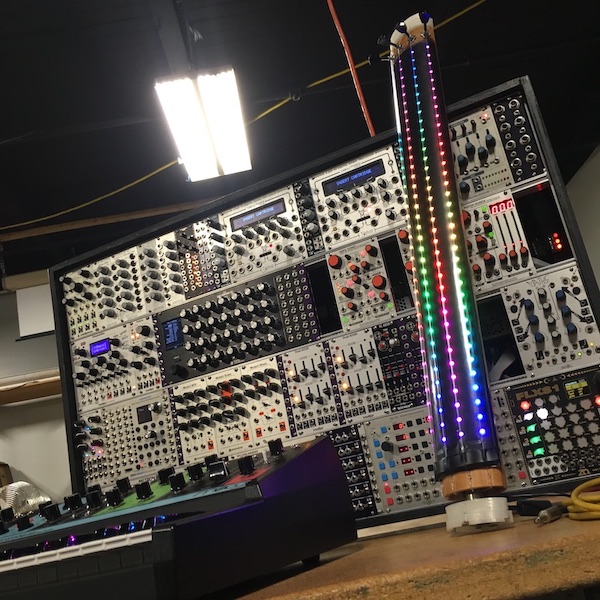
As part of technology startup BRAZENHAUS, I contributed to this prototype of the Martone, a new electronic musical instrument featuring a touch-sensitive interface and highly versatile feature set. The instrument functions as a standalone synthesizer as well as a MIDI controller, and its settings are adjusted via a mobile app. Our team was comprised of four engineers from various backgrounds and disciplines, and we created this prototype over a roughly 14-week period.
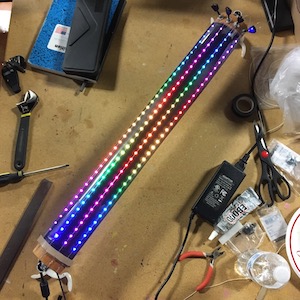
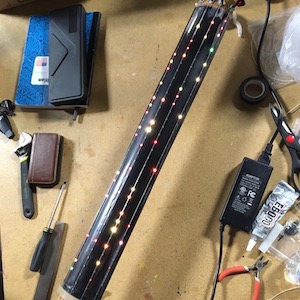
My duties included electrical and software work. I designed and implemented a system including two PJRC Teensy microcontroller boards: one responsible for scanning for user input on the resistive touchscreen, then passing this information to the other for the core operation and sound generation of the instrument. I also worked with another team member to add a third microcontroller responsible for receiving parameter updates from a mobile app and passing them to the primary board for handling.
On the primary microcontroller, I designed and implemented a polyphonic synthesizer featuring adjustable parameters, presets, and reactive LEDs using C/Arduino and the Teensy Audio Library. I also worked to optimize scanning of the resistive touchscreen in order to ensure responsive operation.
As part of technology startup BRAZENHAUS, I contributed to this prototype of the Martone, a new electronic musical instrument featuring a touch-sensitive interface and highly versatile feature set. The instrument functions as a standalone synthesizer as well as a MIDI controller, and its settings are adjusted via a mobile app. Our team was comprised of four engineers from various backgrounds and disciplines, and we created this prototype over a roughly 14-week period.
My duties included electrical and software work. I designed and implemented a system including two PJRC Teensy microcontroller boards: one responsible for scanning for user input on the resistive touchscreen, then passing this information to the other for the core operation and sound generation of the instrument. I also worked with another team member to add a third microcontroller responsible for receiving parameter updates from a mobile app and passing them to the primary board for handling.
On the primary microcontroller, I designed and implemented a polyphonic synthesizer featuring adjustable parameters, presets, and reactive LEDs using C/Arduino and the Teensy Audio Library. I also worked to optimize scanning of the resistive touchscreen in order to ensure responsive operation.
Multidimensional Synthesized Convolution Reverb for Ambisonic Playback in MATLAB
[April 2019]
[paper] [poster]
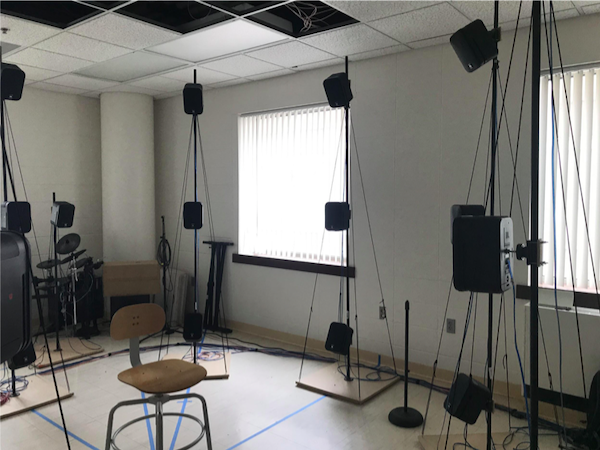
Worked with a group of two other students to create an ambisonic convolution reverb processor in MATLAB. This project extends an impulse response generation script written by Dr. Mark Bocko into a full convolution reverb processor with ambisonic playback as well as the ability to select reverb parameters using a GUI. The end user may provide source audio, choose the dimensions and absorption of the virtual room, and select the virtual source and listening position locations in 3-D space. The processed audio is then sent to a 25-speaker ambisonic playback system, resulting in immersive and spatially accurate sound.
[paper] [poster]
Worked with a group of two other students to create an ambisonic convolution reverb processor in MATLAB. This project extends an impulse response generation script written by Dr. Mark Bocko into a full convolution reverb processor with ambisonic playback as well as the ability to select reverb parameters using a GUI. The end user may provide source audio, choose the dimensions and absorption of the virtual room, and select the virtual source and listening position locations in 3-D space. The processed audio is then sent to a 25-speaker ambisonic playback system, resulting in immersive and spatially accurate sound.
seeLoudness - A Utility for Measuring Integrated Loudness in C
[November 2018]
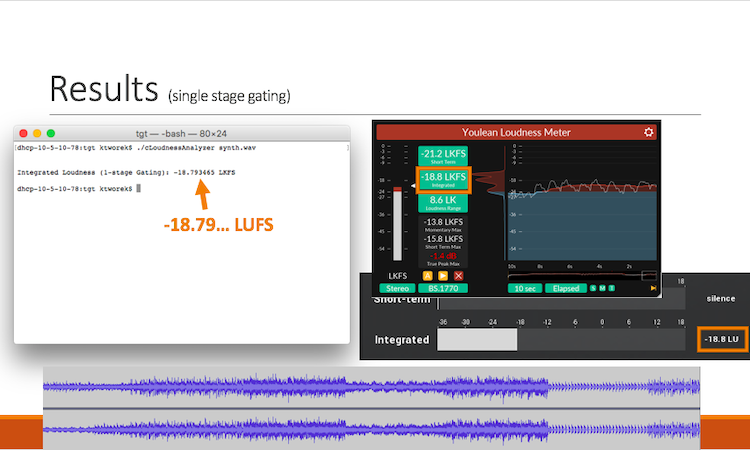
'seeLoudness' offers a simple, fast solution for measuring the integrated, K-weighted loudness (Integrated LUFS) of a stereo audio file. This command-line utility written in C analyzes 16-bit/48kHz stereo WAV files at around 14x real-time, is fully compliant to the ITU-R BS.1770-4 recommendation, and offers accuracy comparable to commercially available, industry-standard metering solutions.
This project was completed for academic purposes, and is non-commercial. seeLoudness utilizes functions from the C filtering library 'sndfilter' by Sean Connelly, the source of which is available at https://github.com/voidqk/sndfilter.
'seeLoudness' offers a simple, fast solution for measuring the integrated, K-weighted loudness (Integrated LUFS) of a stereo audio file. This command-line utility written in C analyzes 16-bit/48kHz stereo WAV files at around 14x real-time, is fully compliant to the ITU-R BS.1770-4 recommendation, and offers accuracy comparable to commercially available, industry-standard metering solutions.
This project was completed for academic purposes, and is non-commercial. seeLoudness utilizes functions from the C filtering library 'sndfilter' by Sean Connelly, the source of which is available at https://github.com/voidqk/sndfilter.
Recording / Production Work
click projects for details, credits, and audio links
Tony & Dom Repucci - The Storm [Single]
Bus Stop Hill - Broken Down on the Side [EP]
[August 2018]
[listen]
Engineering credits: tracking/mixing/mastering
Performance credits: bass on "Mistakes Made" and "Electricity", aux. rhythm guitar on "Lessons Learned"
Misc. credits: producer
[listen]
Engineering credits: tracking/mixing/mastering
Performance credits: bass on "Mistakes Made" and "Electricity", aux. rhythm guitar on "Lessons Learned"
Misc. credits: producer
Better Days [Single]
[December 2017]
[listen]
Recording location: University of Rochester - Rettner Hall
Engineering credits: tracking/mixing/mastering (as member of 3-person team)
Performance credits: drums and guitar
Misc. credits: co-writer (instrumentals)
[listen]
Recording location: University of Rochester - Rettner Hall
Engineering credits: tracking/mixing/mastering (as member of 3-person team)
Performance credits: drums and guitar
Misc. credits: co-writer (instrumentals)
Kyle Tworek - Pretending [EP]
[August 2017]
[listen]
Engineering credits: tracking/mixing/mastering
Performance credits: all instruments and vocals
Misc. credits: songwriting, producer
[listen]
Engineering credits: tracking/mixing/mastering
Performance credits: all instruments and vocals
Misc. credits: songwriting, producer
© Kyle Tworek 2020